
As artificial intelligence reshapes how we interact with data, one architectural shift stands out: the move from CPU-centric computing to GPU-dominant infrastructure. But why did this happen? And what makes GPUs so uniquely suited for AI workloads?
Let’s unpack the evolution, the math, and the mechanics behind this transformation.
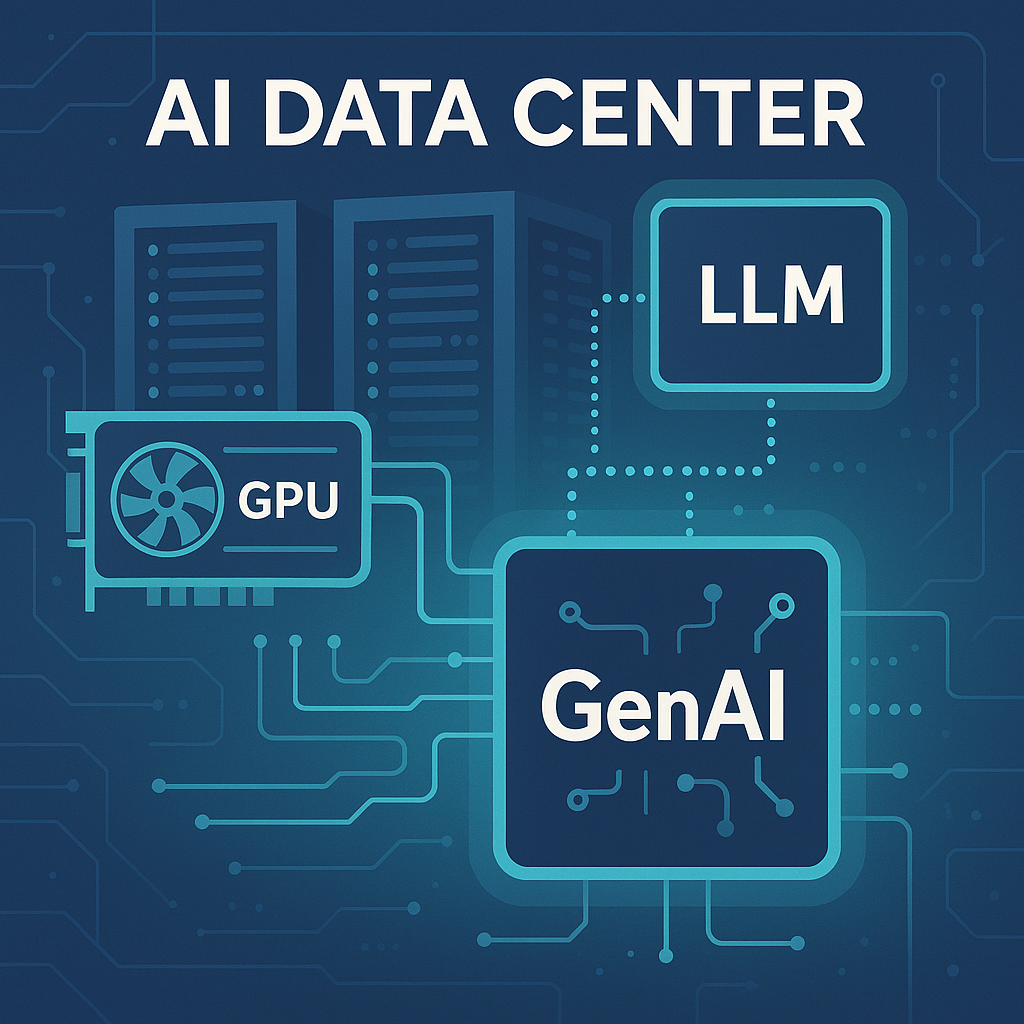
CPUs vs. GPUs: A Tale of Two Architectures
Traditional computing — including Big Data systems — has long relied on clusters of CPUs. These processors are designed for general-purpose tasks, with a few powerful cores optimized for sequential logic, branching, and system orchestration.
GPUs, on the other hand, are built for massive parallelism. With thousands of lightweight cores, they excel at simultaneously performing the same operation across large datasets. This makes them ideal for the mathematical backbone of AI: matrix multiplications, tensor operations, and vector comparisons.
How Graphics Paved the Way for AI Acceleration
GPUs didn’t start as AI engines — they were born to serve the gaming and graphics industries. Real-time rendering demanded:
- Complex lighting and shading
- High frame rates (60–120 FPS)
- Rendering millions of polygons per frame
These requirements pushed GPU vendors to develop highly parallel, math-optimized architectures. Over time, Shaders (system programs) evolved into general-purpose compute platforms, laying the foundation for AI acceleration.
GPUs Building Blocks
Streaming Multiprocessors (SMs): These are core building blocks of a GPU. They contains L1 Cache for fast access to instructions and data.
Processing Cores: These are the actual compute units inside each SM. They perform arithmetic operations for graphics processing and matrix mathematics when used for AI workloads.
Memory Hierarchy: L2 Cache is shared across SMs and they balances latency and bandwidth.
Internal Connectivity: High-speed buses and fabrics connect SMs to memory and other subsystems.
| Feature | CPU | GPU |
| Core Count | Few (4–64) | Thousands inside an SM |
| Execution Style | Semi Sequential, logic-heavy | Parallel, math-heavy |
| Best For | OS tasks, branching logic | Matrix Math, deep learning, graphic processing |
| AI Training Speed | Slow | Orders of magnitude faster |
| Execution Model | Since CPUs process general purpose tasks, they run on MIMD (Multiple Instruction Multiple Data) | GPUs is focused on specific type of task, they use a SIMD model (Single Instruction, Multiple Data) |
| Threading Model | No direct equivalent. Closest comparable is Intel Hyperthreading. | Warp (group of 32 threads) |
Analogy: Chef vs Kitchen Brigade
Imagine a CPU as a master chef — skilled, versatile, and great at handling complex recipes. But slow if asked to flip 10,000 burgers.
A GPU is like a brigade of 1000 junior chefs, each with a spatula, flipping burgers in parallel. Less flexible, but blazing fast for repetitive tasks.
AI Is All About Math — And GPUs Are Math Machines
At the heart of GenAI lies numerical computation. Whether it’s training a model or retrieving knowledge, the process is deeply mathematical:
1. Vector Conversion of Knowledge
- Text, images, and other data are transformed into high-dimensional vectors — arrays of numbers that capture semantic meaning.
- These embeddings represent concepts, relationships, and context in a format that machines can compare.
2. Vector Databases
- These embeddings are stored in specialized databases unlike direct text matching.
- Instead of keyword matching, retrieval is based on numerical similarity and weights — often using cosine similarity or dot product.
3. Semantic Search via Weight Comparison
- When a query is issued, it’s converted into a vector.
- The system searches for nearby vectors — i.e., semantically related knowledge — by comparing weights and distances in vector space.
- This enables contextual retrieval of similar knowledge, far beyond traditional keyword search.
4. Massive Parallel Processing
- All of this — from embedding generation to similarity search — involves tensor operations and matrix math.
- GPUs accelerate these tasks by running thousands of threads in parallel, making real-time GenAI possible at scale.
Then Why Not Just Use GPUs Everywhere?
Despite their speed, GPUs aren’t replacements for CPUs. Here’s why:
- GPUs can’t boot or manage system tasks — they lack BIOS, interrupt handling, and full instruction sets.
- They’re inefficient for branching logic and I/O-heavy tasks.
- Power and thermal constraints make them impractical for lightweight devices.
Final Takeaway
GenAI’s hunger for parallelism, vector math, and high-throughput computation has made GPUs the backbone of modern AI infrastructure. From converting knowledge into vectors, to retrieving it through weight-based comparisons, GPUs enable the scale, speed, and semantic depth that AI demands.
Understanding this architectural shift isn’t just academic — it’s foundational for anyone building, optimizing, or deploying AI systems in the real world.
 Vipul Pathak
Leave a comment